
The Hairy Ape
Introduction to the Author – Eugene O’Neill and his The Hairy Ape
Eugene O’Neill (1888–1953) was one of the greatest American dramatists and a Nobel Prize-winning playwright. He is often regarded as the father of modern American drama. O’Neill introduced realism, psychological depth, and expressionism into American theatre. His plays explore themes such as alienation, identity, loneliness, class conflict, and human suffering.
Some of his famous works include:
- The Hairy Ape
- Long Day’s Journey into Night
- Desire Under the Elms
- Mourning Becomes Electra
The Hairy Ape (1922) is one of his most important expressionist plays. It presents the crisis of modern industrial civilization and the struggle of an individual for identity and belonging.
Brief Summary of the Play
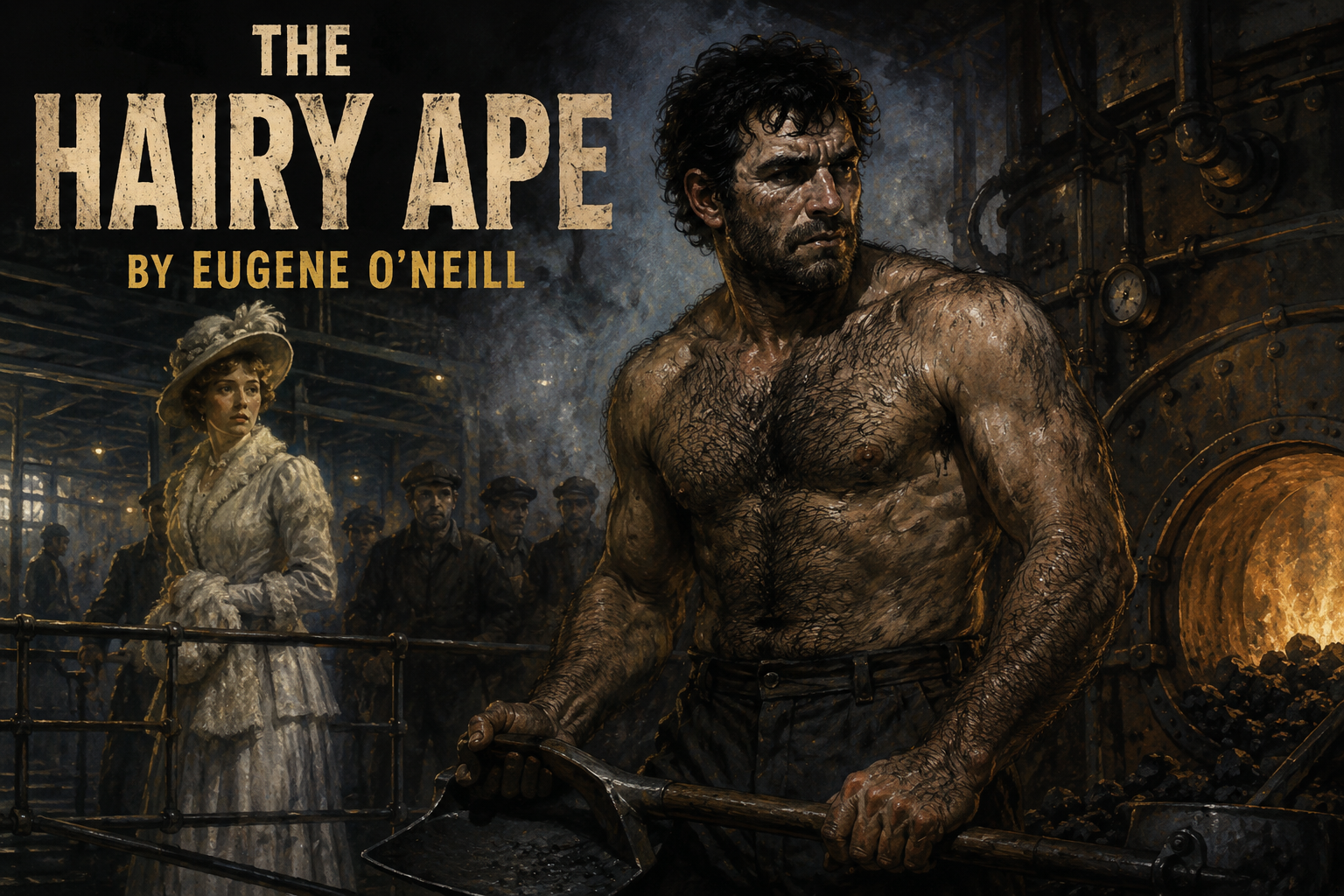
The play revolves around Yank, a powerful stoker working in the engine room of a luxurious ocean liner. Yank is proud of his physical strength and believes he controls the ship because the engines run through his labor. He feels confident that he belongs to the modern industrial world.
However, his confidence is shattered when Mildred Douglas, a rich young woman, visits the stokehole and calls him a “filthy beast” and a “hairy ape.” Her reaction makes Yank suddenly aware of the huge gap between the working class and the upper class.
Disturbed and humiliated, Yank begins a journey to discover his identity and place in
society. He tries to rebel against the rich class and seeks acceptance among workers and revolutionaries, but everywhere he faces rejection.
Finally, in despair, he visits a zoo and attempts to befriend a gorilla, believing it to be his true companion. The gorilla crushes Yank to death, symbolizing the tragic destruction of modern man who no longer belongs either to civilization or nature.
Important Characters
1. Yank (Robert Smith)
Yank is the protagonist of the play. He is physically strong, aggressive, and proud of his labor. Initially, he believes he “belongs” to the industrial world. After Mildred insults him, he undergoes an identity crisis and becomes alienated from society.
Significance:
- Represents the modern industrial worker
- Symbolizes loss of identity
- Victim of class division and industrialization
2. Mildred Douglas

Mildred is a rich upper-class girl who visits the stokehole as part of her interest in social service. She is horrified by Yank’s appearance and calls him a “hairy ape.”
Significance:
- Represents the capitalist upper class
- Symbolizes the superficial sympathy of the rich
- Causes Yank’s psychological collapse
3. Paddy

Paddy is an old Irish sailor who remembers the peaceful days of sailing ships before industrialization.
Significance:
- Represents nostalgia
- Criticizes mechanized modern life
- Symbol of human values destroyed by machines
4. Long
Long is a socialist worker who tries to make Yank aware of class exploitation.
Significance:
- Represents political awareness
- Symbolizes class struggle
5. The Gorilla
The gorilla appears in the final scene of the play.
Significance:
- Symbolizes primitive nature
- Reflects Yank’s inner self
- Represents brute strength without intelligence
Major Themes
1. Alienation
Alienation is the central theme of the play. Yank becomes isolated from society after realizing that he does not truly belong anywhere.
Example:
- Rejected by the upper class
- Ignored by society
- Unable to connect with revolutionaries or nature
2. Identity Crisis
Yank’s journey is essentially a search for identity. He repeatedly asks:
“Where do I belong?”
The play shows how industrial society destroys personal identity.
3. Class Conflict
The play strongly criticizes the division between the rich and the poor.
Upper Class:
- Wealthy
- Comfortable
- Detached from labor
Working Class:
- Exploited
- Physically exhausted
- Socially ignored
4. Industrialization and Mechanization
The stokehole symbolizes the dehumanizing effect of machines. Workers behave like parts of a machine rather than human beings.
5. Primitive vs. Civilized Life
The play contrasts primitive animal strength with modern civilization. Yank ultimately feels closer to the gorilla than to human society.
Motifs in the Play
1. Steel and Machinery
Repeated references to steel, engines, and machines emphasize industrial power and mechanical life.
2. Belonging
The repeated idea of “belonging” reflects Yank’s constant search for identity and acceptance.
3. Animal Imagery
Characters frequently use animal-like descriptions, especially for Yank.
Examples:
- Ape
- Beast
- Gorilla
This motif highlights dehumanization.
Symbols in the Play
1. The Stokehole
Symbolism:
- Industrial hell
- Exploitation of labor
- Mechanical modern civilization
2. The Gorilla
Symbolism:
- Primitive instinct
- Brutal force
- Yank’s lost identity
3. Fifth Avenue
Symbolism:
- Wealth and capitalism
- Social inequality
- Upper-class arrogance
4. The Ship
Symbolism:
- Modern industrial society
- Rigid class structure
- Human beings trapped in machinery.
Conclusion
The Hairy Ape is one of the finest expressionist plays in American literature. Through the tragic journey of Yank, Eugene O’Neill presents the dehumanizing effects of industrialization, social inequality, and alienation. The play remains significant for its psychological depth, symbolic richness, and powerful criticism of modern civilization.
Important FAQs (Frequently Asked Questions)
Q1. Why is The Hairy Ape called an expressionist play?
The play is expressionist because it focuses on inner emotions and the psychological condition of the central character, Yank, rather than on realistic events. The distorted settings, symbolic characters, and exaggerated emotions reveal Yank’s mental suffering.
Q2. What causes Yank’s identity crisis?
Mildred Douglas calling him a “hairy ape” destroys his confidence and makes him realize that society sees him as less than human.
Q3. What does the gorilla symbolize?
The gorilla symbolizes primitive nature and brute force. It also reflects Yank’s realization that he belongs neither to civilized society nor to the animal world.
Q4. How does the play criticize industrialization?
The play shows that industrial society turns workers into machines, destroys individuality, and creates social inequality.
Q5. What is the significance of the ending?
Yank’s death shows the tragic condition of modern man who becomes alienated from both society and nature.
Read More:
The Old Man and the Sea STUDY ENGLISH LITERATURE
Daddy by Sylvia Plath | Summary, Structure and Style, and Important Lines STUDY ENGLISH LITERATURE
You can also visit my YOUTUBE CHANNEL: