
Plato’s – Allegory of the Cave
Introduction:
One of the most famous philosophical passages in The Republic is Plato’s Allegory of the Cave, written in 380 BCE.
It appears in Book VII and explains Plato’s theory of knowledge, reality, education, and the philosopher’s role in society. Through a powerful metaphor, Plato illustrates how most people live in ignorance, mistaking appearances for reality, while philosophy enables individuals to discover truth.
Summary of Plato’s Allegory of the Cave
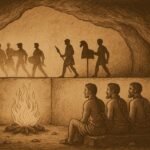
Plato asks us to imagine a group of prisoners who have been chained inside a dark cave since birth. They are unable to move their heads and can only look at the wall in front of them.
Behind the prisoners burns a fire, and between the fire and the prisoners there is a raised pathway. People are carrying various objects, such as statues, animals, and everyday items. The fire casts the shadows of these objects onto the cave wall.
Since the prisoners have never seen the real objects or the outside world, they believe that the moving shadows on the wall are the only reality. They also hear echoes of voices and assume that the shadows themselves are speaking.
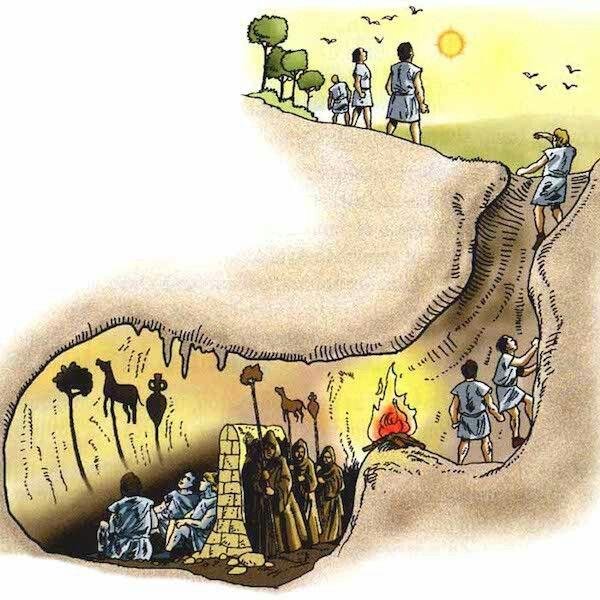 One day, one prisoner is freed. Initially, he is confused and uncomfortable because the firelight hurts his eyes. Gradually, he realizes that the objects casting the shadows are more real than the shadows themselves.
The prisoner is then taken outside the cave. At first, the sunlight blinds him, but slowly his eyes adjust. He begins to see reflections in water, then plants, animals, mountains, the sky, and finally the sun itself. He understands that the outside world is the true reality, while the cave contained only illusions.
Filled with compassion, he returns to the cave to free the other prisoners. However, they ridicule him because his eyes can no longer easily adjust to the darkness. They refuse to believe his account of the outside world and even threaten to kill anyone who attempts to free them.
Symbolism in Plato’s – Allegory of the Cave
| Symbol | Meaning |
| The Cave | The world of ignorance and illusion |
| Prisoners | Ordinary people trapped by false beliefs |
| Chains | Ignorance, prejudice, and lack of education |
| Shadows | Appearances, opinions, misinformation, and incomplete knowledge |
| Fire | Limited or artificial source of knowledge |
| Journey Out of the Cave | Education and philosophical inquiry |
| Sun | Truth, wisdom, and the Form of the Good |
| Return to the Cave | The philosopher’s duty to educate society |
Philosophical Meaning of Plato’s Allegory of the Cave
- Appearance vs. Reality
Plato argues that what we perceive through our senses is often deceptive. Most people mistake appearances for reality. True knowledge requires intellectual understanding rather than mere sensory experience.
- Theory of Forms
The allegory supports Plato’s Theory of Forms, according to which the physical world is only an imperfect copy of the eternal and perfect Forms.
For example:
- A beautiful flower may fade.
- The perfect Form of Beauty never changes.
- Physical objects are temporary, but Forms are eternal.
Thus, true knowledge is knowledge of these perfect Forms.
- Education
According to Plato, education is not simply filling the mind with information. Instead, it is the process of turning the soul toward truth.
The freed prisoner represents a person whose mind has been transformed through education.
- The Philosopher
The philosopher is the one who escapes ignorance and discovers truth. However, Plato insists that philosophers should not remain isolated. They have a moral responsibility to return to society and guide others, even if they face misunderstanding or hostility.
The Sun as the Form of the Good in Plato’s Allegory of the Cave
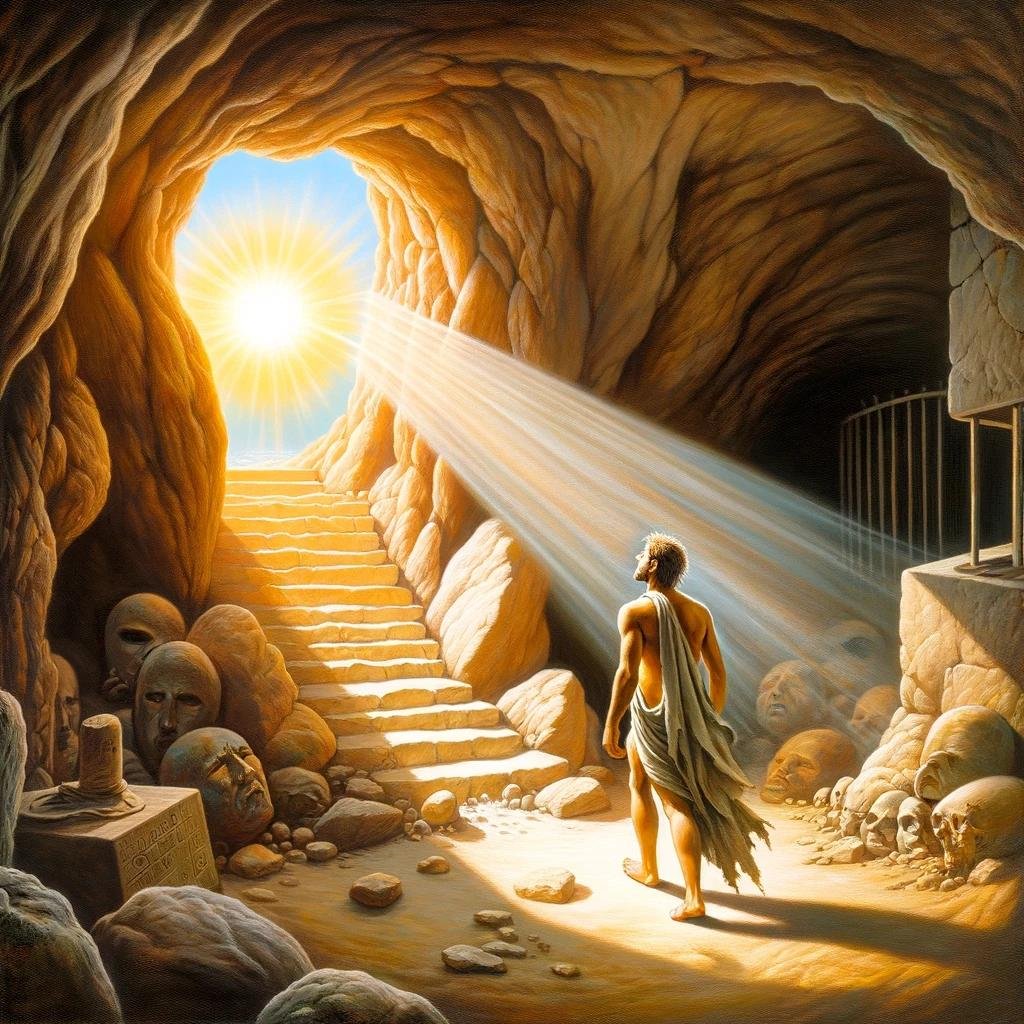
Outside the cave, the highest object is the Sun.
The Sun symbolizes the Form of the Good, which is the highest reality in Plato’s philosophy.
Just as the sun gives light that makes vision possible, the Form of the Good gives understanding that makes knowledge possible.
Without the Good, nothing can be truly understood.
Relevance in the Modern World of Plato’s – Allegory of the Cave
The Allegory of the Cave remains remarkably relevant today.
Examples include:
- Social media misinformation creating false perceptions.
- Propaganda influencing public opinion.
- People accepting stereotypes without questioning them.
- Education encouraging critical thinking rather than memorization.
- Scientific discoveries replacing outdated beliefs.
The allegory reminds us to question assumptions and seek evidence before accepting claims as truth.
Major Themes
- Reality versus illusion
- Knowledge versus ignorance
- Education as enlightenment
- Philosophy and wisdom
- Truth and justice
- Intellectual freedom
- Moral responsibility
- Critical thinking
Critical Appreciation of Allegory of the Cave
Allegory of the Cave is admired for its combination of philosophy and vivid storytelling. Instead of presenting abstract arguments alone, Plato uses an unforgettable image to explain profound ideas about human existence. The allegory has influenced philosophy, education, psychology, political theory, literature, and religious thought for more than two thousand years. It encourages readers to challenge accepted beliefs, pursue genuine knowledge, and recognize that intellectual growth often requires questioning comfortable illusions.
Key Quotations
“The prison-house is the world of sight.”
“The sun is the offspring of the Good.”
“Education is not what some people declare it to be, namely, putting knowledge into souls that lack it; rather, it is turning the soul toward the light.”
Conclusion
Allegory of the Cave is a timeless metaphor for humanity’s journey from ignorance to knowledge. Through the story of the prisoners, Plato demonstrates that truth requires intellectual effort, education, and philosophical reflection. The allegory teaches that appearances can be misleading, genuine knowledge lies beyond sensory perception, and those who attain wisdom have a responsibility to enlighten others. Its enduring message continues to inspire critical thinking and the pursuit of truth across disciplines and cultures.
Important Examination Questions
Short Questions
- What is the Allegory of the Cave?
- What do the shadows symbolize?
- Why are the prisoners chained?
- What does the sun represent?
- Why does the freed prisoner return to the cave?
Long Questions
- Explain Plato’s Allegory of the Cave in detail.
- Discuss the symbolism of the cave and its philosophical significance.
- How does the Allegory of the Cave explain Plato’s Theory of Forms?
- Examine Plato’s concept of education through the Allegory of the Cave.
- Discuss the relevance of the Allegory of the Cave in the modern world.
Read More:
Elaine Showalter’s Towards A Feminist Poetics – STUDY ENGLISH LITERATURE
Follow on You Tube also: